JOSEPH D. JACKSON
  • Home
  • Books
  • Watercolor
  • Teaching
  • In the Media
  • Blog
  • Contact

The Unforeseen Perks of Being a Teacher (Part III)

6/12/2023

1 Comment

 
Picture
The Mogollon people were the first ones here. Say Muggy-yawn and you've said it right. These desert- and mountain-dwellers first emerged around 200 CE, and though they disappeared by the 1500s, they left distinctly impressive cliff dwellings, burial grounds, art, and tools in their wake. Before that, this land belonged to the anonymous; animals like the elk and the rattlesnake, fish like the Gila trout, rocks like the 25-million-year-old volcanic flows towering above us. 
Read Part I Here!
Read Part II Here!
​My seven Gila trout students and I were in good spirits. The air was cool, the sun hadn't yet penetrated the depths of the canyon, and it was easy hiking, all nicely downhill. We may have had thoughts about the trip back up, but we didn't voice them. That was for later. 

Down near the bottom, near the stream, we find an old gold mine. Broken and rotted lumber reclaimed by the mountains. A filled-in tunnel leading to the center of the Earth for all we knew. In the 1870s, gold was first found here. By 1889, several mines had been established, cabins along with them, and the tiny but bustling town of Mogollon was taking shape. At the turn of the century it boasted a school, a post office, a jailhouse (essential in gold country -- between 1872 and 1873, for example, the Mogollon-Silver City stagecoach line was robbed 23 times by the same ruffian), and in 1915 -- arguably the area's peak of activity -- it added five saloons, two hotels, four general stores, and countless brothels (another gold country staple). Its population was around 2,000.  

World War I ushered struggles the world over; for the folks of Mogollon, it meant a lower demand for gold and silver. Many of their mines had come to be depleted anyway, but global goings-on forced many to abandon their geologic dreams for good. World War II, just a few decades later, was another blow; the lust for gold was dampened irreversibly, and the tales of this fleeting Wild West melted into legend. 
Picture
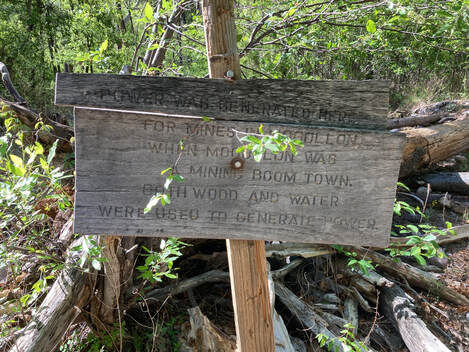
The stream we fished used to provide hydroelectric power for gold mining efforts in the area.
The stream is as beautiful as I imagined a Gila trout stream would be. Somehow, all those years ago when I first realized these fish existed, I pictured their home just like this: small, compact, freestone, wiggling a palsy signature through the canyons, dashing white around boulders, leaping toward forever. I told the students that we'd be fishing our way downstream, and they were relatively free to wander as long as they didn't 1.) go upstream past the point we'd entered the creek at, 2.) go downstream below me, or 3.) go exploring solo. They accepted the terms and conditions. I helped a few get rigged up with Parachute Adams flies. 

The land holds its history like a cup holds water. All of the lifetimes spent here, either scraping survival from the bare rocks a thousand years ago or hacking away at a vein of quartz, betting your life on gold, seem to hover like clouds. Somehow, throughout that cosmic morning, we realized that our lives were becoming part of this story. Our passions to find the Gila trout were stitched in the sky. 
Picture
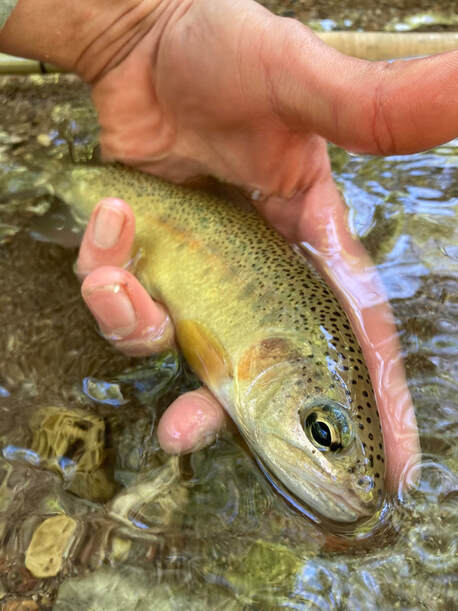
Not my first Gila trout, but the first one cooperative enough for a photo.
My first Gila trout was perhaps five inches long. "Small," you'd call it with some accuracy, but then again these fish don't get huge. Fifteen inches is the trout of a lifetime. Ten and I'd be skipping on the gravel bar. Somehow, though, inches on a Gila trout seem profoundly larger than they'd be on, say, a rainbow; proportional to the uphill battle their species has faced in this tiny and inhospitable corner of the world. They're limited to a number of streams (not that you can count on one hand, but the fact that you can count them at all is fairly alarming) and were part of the Endangered Species List in 1973. Exhaustive efforts by various entities -- Arizona and New Mexico's respective state fisheries agencies, the U.S. Fish and Wildlife Service, the U.S. Forest Service, the Western Native Trout Initiative, and the Arizona chapter of Trout Unlimited, among others -- have elevated these Gilas to fishable population levels. Awareness, hatchery supplementation, and habitat restoration have proven to be the fish's antidote to extinction; the tools required to bring them back from the brink and allow them to thrive.
Learn more about Gila trout efforts here!
We didn't have a lot of time that morning, but we made the most of it. Students wandered throughout the riparian zones, reptile hunting or chasing Gilas or looking for gold. The fishing could not have been better. It began slowly, with fish coming unexpectedly, but as we learned where to look for them and what flies to catch them on, our acquaintance with Gila trout grew. 

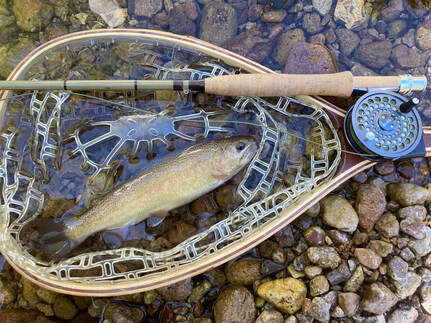
The four-weight fly rod I bought specifically for Gila trout shined; it made tight casts under bankside cover and launched bow-and-arrows into protected holes. The trout's strength echoed through the supple fiberglass. The sun crawled higher and the fish got more skittish, but as they did, I stumbled upon a big plunge pool with what turned out to be several brutes hiding underneath. My largest Gila trout was a plump ten-incher that ate an olive Woolly Bugger. I'd hooked one even bigger -- perhaps thirteen or fourteen -- but it wouldn't be a fishing trip if the big one didn't get away. And as cool as seeing and feeling those fish was, it was nothing compared with helping a student catch their first Gila just a few minutes later. 

It was a prolonged and often frustrating journey. It's hard to describe for someone else what you yourself have been doing instinctually for over a decade. Cast there. No, two inches upstream. Mend it as soon as the fly gets bumped by the stick. Small mend. Now rip out some line. Do it again. Fish. Set the hook. Did you poke him? No. Try again. He might come back. 

After three or four missed opportunities, it happened. The stars aligned, and there in the canyon where gold miner's tales were once told and the Mogollons scrabbled a living from the cobbles, my student hooked a Gila. Under a tree, the pool the color of honey. He towed it out and beheld it the only way you should: reverence, unbridled joy, a grin stretching eye to eye. I couldn't help but think he looked a lot like I did when the fly fishing bug first began -- blissfully ignorant to the terminal affliction now working it's way into his soul. No idea that the fish wasn't the only one hooked. 

That's about the best I can hope for as a teacher, I think. Who cares if students forget when the American Revolution ended. This one just held one of the rarest trout in the country and their heart kicked like a wild horse. They asked a question and received an answer, a signal as if from another planet. They learned to love something for its own sake. He won't lose that, not ever. 

We hiked up and out of the canyon in the building afternoon. Students dozed in the backseats on the drive back to camp. In the city we stop at Sonic per their requests and they ask if I -- meaning, the school -- will pay for it. 

I whip out the credit card. 

"You got up at 3 a.m. to go fishing. Get whatever you want." 
1 Comment
CIM Escorts Wallasey link
6/10/2025 07:21:38 am

I love how this blog post seamlessly blends historical accounts and personal experiences.

Reply


Leave a Reply.

    About 

    "Maunderings" is a blog of ramblings and recollections from the Alaskan outdoors. 

    Categories

    All
    Fishing
    Hunting
    Writing

Proudly powered by Weebly
  • Home
  • Books
  • Watercolor
  • Teaching
  • In the Media
  • Blog
  • Contact